Robert Sheaffer's Books

 Critical Thinking
About UFO Claims
Critical Thinking
About UFO Claims
by Robert Sheaffer
What
explains the human fascination with UFOs? The first reported sighting
of what was then called "flying saucers" was by private pilot Kenneth
Arnold on June 24, 1947. Within a few weeks, an entire "wave" of saucer
sightings swept across the U.S., and soon across the world. And within
a few years this had expanded to give us UFO crashes, the Men In Black,
UFO bases, military and intelligence agency conspiracies, NASA
conspiracies, alien abductions, crop circles, alien autopsies,
alien-human hybrids, cattle mutilations, and the list just continues to
grow.
Do the "saucers" (later renamed "UFOs") represent visitors
from some other planet, or possibly even something more bizarre? How
have they evaded unambiguous detection for about seventy years? Is this
because the methods of science cannot capture them? Or do reports of
UFOs have much in common with reports of ghosts, witches, Bigfoot, and
other creatures that are widely discussed and widely believed, but
exist only in the imaginations of those who pursue them?
Bad UFOs discusses some of the most famous and controversial UFO cases of all time, from a rational and scientific perspective:
· the Betty and Barney Hill ‘UFO abduction’ account
· the Phoenix Lights
· the Roswell ‘UFO crash,’ and the recent ‘Roswell Slides’
· the supposed ‘UFO landing’ in Rendlesham Forest
· Travis Walton’s ‘UFO abduction’ claim
· UFOs seen using Night Vision equipment
· Steven Greer’s Disclosure Project, and ET Contact Protocols
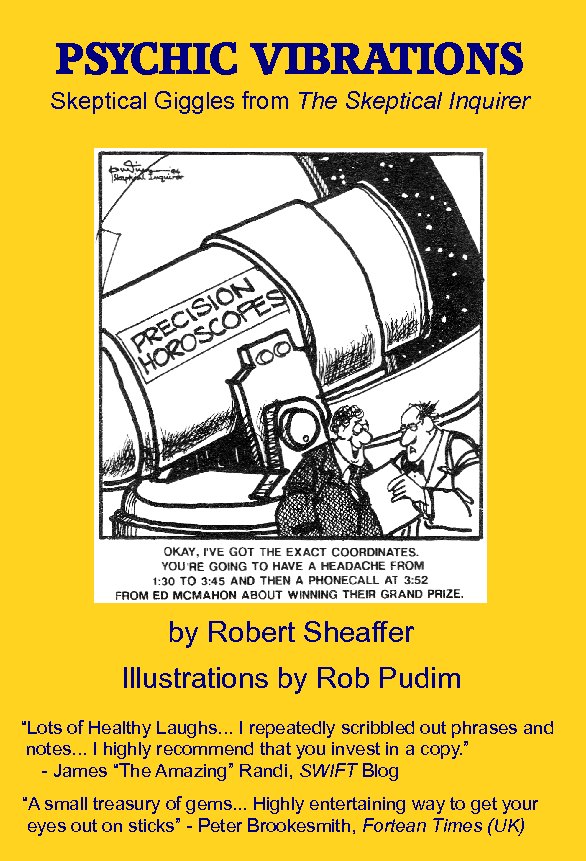 At Last – A Skeptical Book that’s not just Informative, but FUN
to read!
Psychic
Vibrations
Skeptical Giggles from the
Skeptical Inquirer
By
Robert Sheaffer - Illustrations by Rob Pudim
And enter
discount code SPK8R6GT using that link to get 25% off!
“Lots of Healthy Laughs... I repeatedly
scribbled out phrases and
notes... I highly recommend that you
invest in a copy.”
-
James “The Amazing” Randi, SWIFT Blog
Psychic
Vibrations is now available as an E-Book from
JREF, the James Randi Educational
Foundation.
At Last – A Skeptical Book that’s not just Informative, but FUN
to read!
Psychic
Vibrations
Skeptical Giggles from the
Skeptical Inquirer
By
Robert Sheaffer - Illustrations by Rob Pudim
And enter
discount code SPK8R6GT using that link to get 25% off!
“Lots of Healthy Laughs... I repeatedly
scribbled out phrases and
notes... I highly recommend that you
invest in a copy.”
-
James “The Amazing” Randi, SWIFT Blog
Psychic
Vibrations is now available as an E-Book from
JREF, the James Randi Educational
Foundation.
UFO SIGHTINGS - The Evidence
Prometheus Books, Amherst, NY, cloth, 1998, $25.95. ISBN
1-57392-213-7.
"should be ranked among the very best books on the UFO
subject." James W. Moseley, veteran UFOlogist and publisher of Saucer Smear.
Engaging and entertaining, this book is the most up-to-date overview of the
UFO phenomenon. UFO Sightings is unique because it gives the
reader a broad perspective of the world of UFOlogy, dealing with most major
cases and trends, while offering references and a commentary to provide a clear
perspective. Incidents and photographs are scrutinized within a framework of
objective science. Based in part upon material previously published in
The UFO Verdict, old cases are brought up-to-date and new cases
are incorporated to provide a lively and comprehensive overview of the
contemporary UFO scene, strongly supported by references to primary sources and
readily-available, fully-comprehensive references. UFO
SIGHTINGS is an invaluable source for skeptical inquirers.
From Sky and Telescope Magazine, Nov., 1981
by
Ronald A. Schorn
The author has produced a useful, informative, interesting, and well-written
work. Furthermore, he has created that rarity of rarities - a book about UFOs
that's a lot of fun to read. Most treatments of the subject, whether pro or con,
are filled with detail, take themselves much too seriously, and are utterly dull
and boring.
Sheaffer is a free-lance writer who has done quite a bit of UFO investigating
on his own. He is a good writer, and to judge by what is in this book, he knows
his astronomy as well. Rather than bewilder the reader with hundreds of
unrelated items, he takes a small number of the most celebrated UFO flaps and
discusses them thoroughly.
One's interest is seized as early as page 4, where former President Jimmy
Carter's 1969 UFO sighting is taken up. Just about everybody knows Carter saw a
UFO, but few seem to know the sequel to the story. It took Sheaffer a lot of
effort, but he finally tracked down evidence establishing the correct date of
the incident. That done, it was easy to show that Venus was at the same altitude
and in the same direction as the UFO at the time and date the observation was
made. This incident illustrates an important point: not everyone who files a UFO
report is obscure and unreliable. In fact, witnesses are usually sober,
reliable, and sincere, and often have some standing in the community...
The UFO "movement" has had a long, complex, raucous history, and the author
threads his way neatly through the tangle of acronyms that litter the
organizational UFO scene. Here is probably the most useful summary in print of a
neglected side of a complex phenomenon....
Sheaffer has coined the interesting term "jealous phenomenon" to cover the
whimsical behavior of UFO's, ESP, and similar oddities. This "jealousy" is the
critical difference between UFO's and legitimate, albeit poorly understood,
scientific phenomena. Your typical unidentified flying object is very choosy
about when and where it will appear. Apparently, its behavior is governed by an
overriding concern for human thoughts and emotions - it is determined to thwart
all human attempts to verify its existence......
All in all, Sheaffer sees UFOlogy as a powerful social movement which,
fundamentally, is a reaction against science and reason. He blends this view
with specific cases and general background in this dandy work, always providing
references so the reader can check up on him. If you're only going to have one
book on UFO's, this is the one....
The Making of the Messiah
Prometheus Books, Buffalo, NY, 1991, Cloth, $24.95. ISBN 0-87975-691-8
![[Image-Banner]](images/mak.jpg)
Book Confronts Christianity with New Challenge
A new work published by Prometheus Books confronts Christianity with its
greatest challenge in many a year. "The Making of the Messiah" by Robert
Sheaffer differs from conventional works of Freethinkers by suggesting a
radically different picture of the rise of Christianity. The book describes, to
use Nietzsche's phrase, "The Birth of Christianity from the Spirit of
Resentment." It tells why Christianity could only develop as it did, emerging
from the envious anger of the lower classes. It shows how Christian writers
altered historical facts to make the new religion "sell" better among those
seething with resentment against Roman power and wealth. By looking at the
chronological evolution of Christian writings and doctrine, exactly as skeptics
investigate contemporary accounts of UFO abductions or psychic wonders, it is
possible to infer the kinds of objections that the infant Church must have been
struggling to meet, and from these long-suppressed objections deduce probable
historical fact. This new perspective radically impacts Biblical criticism, in a
manner that Humanists and Freethinkers will wholeheartedly applaud.
"The Making of the Messiah" presents a compelling argument that Jesus was
never "crucified" by the Romans, or anyone else. The familiar Gospel account of
Jesus' death is termed the "cruci- fiction story." Biblical scholars generally
acknowledge that the confusing and contradictory Gospel accounts of Jesus' two
trials make absolutely no sense from the perspective of either Roman or Jewish
law. Resolving this dilemma, the book presents compelling evidence that Jesus
was indeed condemned by the Sanhedrin as stated in Mark 14:64, stoned to death,
and hanged on a tree until sundown: the inescapable penalty under the Mosaic law
for blasphemers and heretics. All of the ancient Rabbinical texts mentioning
Jesus' death are totally consistent in recalling that he was "slain and hanged
on a tree." There are even a few passages remaining in the oldest books of the
New Testament proclaiming Jesus to have been slain and "hanged on a tree" - for
example, Acts 5:30 and Galatians 3:13. These passages are NOT metaphor: they
describe the punishment Jesus MUST have suffered if found guilty of the charges
he faced! (See Deuteronomy 13:10; 21:22.) How did the cruci-fiction story arise?
Several decades after Jesus' execution, when the infant Church sought to recruit
converts among the Gentiles, the tale of a Jewish prophet "slain and hanged on a
tree" probably failed to excite or inflame the listener. But when the story was
changed to have Jesus "crucified" by the Romans, the tale electrified the
resentful throughout the vast Empire.
Another subject covered in great detail is Jesus' supposed "Virgin Birth." In
recent years even many liberal Christians have been willing to question this
highly-dubious claim. They quietly assume that Jesus must have been the natural
son of Joseph. What they do not seem to realize is that it is absolutely clear
(see Matthew 1:19) that Joseph knew the child was not his, and that he believed
Mary to be guilty of adultery. This is abundantly confirmed by a number of other
ancient texts, both Christian and Jewish. Therefore, unless Mary's pregnancy is
of supernatural origin, she is an adulteress. Tracing the development of
Christianity's various accounts of Jesus' origin, it becomes obvious that the
"Virgin Birth" fable, which was not taught until nearly a century after Jesus
was born, was invented as a "cover story" to mask the shameful reality of Jesus'
illegitimate birth. The gospels of Mark and John say nothing whatever about
Jesus' birth; the authors of those gospels must have assumed that the reader
already knew of Jesus' illegitimacy, which intrudes upon the text in several
places. The genealogies of Jesus given in Matthew and Luke differ because the
former was obviously compiled by someone hostile to the new religion. It lists
among Jesus' ancestors some of the most notorious disinherited kings and fallen
women of the Davidic line. The problem was fixed in Luke, whose genealogy
contains only respectable names. Because bastard children were treated extremely
harshly under the Mosaic law, it is not surprising that Jesus chafed at the
restrictions The Law placed upon him, claiming the inspiration of a "higher law"
from above. Jesus' experience of being "despised and rejected" owing to an
accident of birth shaped the very fabric of early Christianity, and drew
together under that religion's banner all who chafed at living under The Law.
What set Jesus apart from other Messianic pretenders was the claim that he
arose from the dead. The evidence offered in support of this claim is
scrutinized in detail. When these accounts are examined in chronological order
of composition, in light of long-suppressed Roman-era criticisms, a clear
pattern emerges. The earliest accounts make the least-convincing claims of an
actual, physical resurrection. Paul sees a vision of a risen Jesus, which is
worthless as "evidence" for anything. As time progresses, Christianity's claims
that people had sighted an actual, physical risen Jesus become more definite.
Many ancient manuscripts of the earliest gospel, Mark, contain absolutely no
sightings of a risen Jesus, whose resurrection is merely inferred because his
body was not where it had been left. Mark 16:9-20, which describes such
sightings, was written years later, to answer objections that nobody actually
SAW Jesus after his supposed resurrection. The only reasonable conclusion to be
drawn is that the supposed resurrection never occurred.
Robert Sheaffer is the author of "Resentment Against Achievement"
(Prometheus, 1988). Laissez Faire Books hails it as "a modern classic,"
comparing it to the works of H. L. Mencken, Friedrich Nietzsche, and Ayn Rand.
Success Magazine writes that "the book crackles with ideas that others have
failed to perceive, or have been too timid to express." Sheaffer's first book
was "The UFO Verdict" (Prometheus, 1981), a highly-skeptical analysis of UFO
mania, about which Sky and Telescope magazine said, "if you're only going to
have one book on UFOs, this is the one." He is a regular columnist for The
Skeptical Inquirer.
Resentment Against Achievement
Prometheus Books, Buffalo, NY, 1988, Cloth, $27.95. ISBN 0-87975-447-8.
From SUCCESS Magazine, November, 1988, p. 4:
Editor's Note by
Scott DaGarmo
Resentment Against Achievement - A Motivational Tour de Force
![[Image-Banner]](images/raa.jpg) "Wealth is crime enough to him that's poor."
-Sir John Denham (1615-1669)
"Wealth is crime enough to him that's poor."
-Sir John Denham (1615-1669)
Those who hate achievement have made their mark throughout
history.
Angry mobs inflamed by envy destroyed the magnificent works of
ancient civilization. In their insane riots, these madmen even dismembered the
statues we still treasure for their beauty, despite their missing limbs.
Today we see the hatred of achievement in slashed tires, vandalized
classrooms, and sabotaged office machines.
We see it in a hostile suspicion
toward "greedy capitalists," who are depicted as exploiters rather than what
they really are - the creators of jobs and wealth.
We see it in a surly
animosity toward managers and owners, who are reviled as enemies despite the
fact that they would like nothing better than to inspire the resentful with a
desire to achieve. Instead of seeing employers as powerful economic allies, the
resentful scorn their values, then blame "the system" on their not being able to
find work.
We see it among intellectuals, who seethe with jealousy at the
sight of individuals less educated than they making bigger incomes.
We see
it in lower-class toughs, whose poverty is "an inevitable consequence of the
achievement-hating values they preserve and (forcibly) transmit."
All this
and more makes up the thesis of a new book by Robert Sheaffer entitled
"Resentment Against Achievement". Subtitled "Understanding the Assault Upon
Ability," the book crackles with ideas that others have failed to perceive, or
have been too timid to express.
The rhetoric of resentment is highly
polished, and achievers are often left speechless in its onslaught. Within this
book is a reply to virtually every defense made for the resentful. For example,
says the author, people do not steal because they are poor. (A fatuous notion
when you note that what is stolen today are not loaves of bread and beans but
luxury items like jewelry and stereos that are fenced for drugs.) Rather, they
are poor because they steal. Sheaffer makes a rational - rather than moralistic
- case that the "upper-class" values of honesty, reliability, self-discipline,
and respect for property are integral to success for anyone.
Similarly,
Sheaffer asserts that what is needed in education is nothing less than an
assault on lower-class culture. Sheaffer is not talking about genocide, but
about a "benign cultural imperialism" allied at recruiting lower-class members
into the upper classes by teaching them how to succeed.
Don't mistake
Sheaffer for a bigoted arch-conservative. He is a libertarian, with a powerful
belief in individual liberties, free trade, and open opportunity. He has
articulated a philosophy for a complex, urban, high-tech, competitive,
entrepreneurial society - a philosophy that affirms a new-age morality based on
accomplishment.
This book will offend those with rigidly conventional
religious views, and I suggest they do not read it. On the other hand, those who
thrive on the elixir of fresh insights will be delighted as the author
excoriates religion for romanticizing, and hence perpetuating, economic
incompetence. Sheaffer urges the impoverished to break away from a slave
morality that encourages passivity, and embrace a new morality based on the
pride of achievement.
Today, you don't need to be born wealthy to be
perceived as a member of the higher classes, says Sheaffer. "Those who adopt
higher-class values and ethics will find themselves gradually accumulating so
much money that no one will doubt their status any longer."
He urges
everyone to experience the joy of being achievers, those fortunate people who
"create because of an inner fire urging them onward."
For all its harsh
denunciation of the resentful, this book is a positive call to action not to
harm people but to help them succeed. Some will see this work as mainly
political. But the author has also written a valuable tour de force of
motivation with a message for us all:
Harboring resentment is
self-destructive. It keeps you from succeeding.
All the above books are still in print. They can be ordered from your
local bookstore, or directly from Prometheus Books at 1-800-421-0351
Or, you can FAX your order to Prometheus at 716-691-0137
They can also be ordered on-line from 
On February 2, 1999, on the 94th anniversary of Ayn Rand's birth, Penn State
Press will release a major anthology, co-edited by Mimi Reisel
Gladstein and Chris Matthew Sciabarra, entitled:
Feminist Interpretations of Ayn Rand
I contributed a chapter on "Rereading Rand on Gender in the Light of Paglia."
Other contributors to the volume include Nathaniel Branden, Barbara Branden,
Camille Paglia, and Joan Kennedy Taylor.
The UFO Invasion
Edited by Kendrick Frazier, Barry Karr, and Joe Nickell. Prometheus Books,
Buffalo, NY, 1997
An outstanding collection of papers, many of them reprinted from The Skeptical Inquirer,
containing up-to-date and reliable information on many famous UFO
claims such as The Roswell Incident, Alien Abductions, and Government Coverups,
written by authors like Philip J. Klass, Joe Nickell, James Oberg, Gene Emery,
Robert A. Baker, etc. I contributed an article on the Gulf Breeze UFO
Photos.
The Encyclopedia of the Paranormal
Edited by Gordon Stein. Prometheus Books, Buffalo, NY, 1996
I contributed the articles The Philadelphia Experiment and
Unidentified Flying Objects. In fact, I wrote everything that
begins with the letter "U".
Funk & Wagnalls New Encyclopedia
Norma H. Dickey, Editor-in-chief. Funk & Wagnalls, Inc., 1984.
I contributed the article Unidentified Flying Objects, in Vol.
27, on p. 159.
Extraterrestrials - Where Are They?
Edited by Ben Zuckerman and Michael H. Hart.
Cambridge University Press,
1995 (second edition)
I contributed the paper An Examination of Claims that Extraterrestrial
Visitors to Earth Are Being Observed. Other contributors to the volume,
taken from papers presented to a Conference at the University of Maryland,
include Freeman Dyson (Jim Oberg and I had lunch with him), Sebastian von
Hoerner, Ronald Bracewell, Jill Tarter, and the late Cyril Ponnamperuma.
Alien Discussions -
Proceedings of the Abduction Study Conference Held at MIT
Edited by Andrea Pritchard et. al. Cambridge, Ma: North Cambridge Press,
1994
This was the now-famous conference organized by John Mack, Budd Hopkins,
David E. Pritchard, and David Jacobs. I contributed the paper A Skeptical
Perspective on UFO Abductions, on p. 382. When C. D. B. Bryan wrote up
his account of this conference, Close Encounters of the Fourth Kind,
so beloved of pro-abduction UFOlogists, he somehow forgot to
mention my paper, as well as several others he apparently didn't like.
Major Articles I Have Written
Feminism, the Noble Lie
Free Inquiry, Spring, 1995.
Truth Abducted
Book review, Scientific American, November, 1995.
Psychic Vibrations
is my regular column in The Skeptical Inquirer
Go to The Debunker's Domain
Go to Robert's Home Page